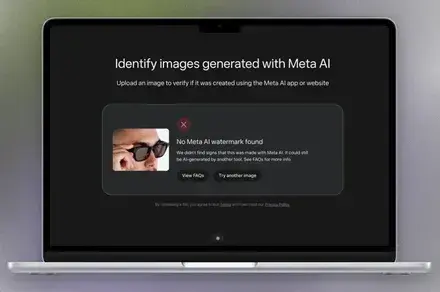
Meta's Detection Gap
Meta's artificial intelligence (AI) image detection system is failing to identify pictures generated by its own Muse Image AI. A recent analysis revealed this significant flaw. The company had just launched two new generative AI tools, Muse Image and Muse Video, earlier this week.
Breaking news
 Town AI Secures $108 Million Series B, Valued at $1 Billion After $55 M Pre‑Series
 Apple Prepares for Major Product Launch Event on October 28
 Apple Releases Release Candidates for watchOS, tvOS and visionOS 27.2
 Apple Limits iPhone Duo and iPhone 18 Pro Max to Reservation-Only Sales in Japan and South Korea
These tools allow users to create images and video clips from simple text prompts. However, their rollout quickly generated controversy. Meta had automatically enrolled Instagram users into the system. This decision allowed others to use their public posts for AI training.
The core issue lies with Meta's inability to consistently recognize AI-generated content from its own platform. This raises questions about the effectiveness of its detection technologies. If Meta cannot identify images from its own AI, how will it handle content from other sources? This oversight could have broad implications for content moderation.
What Are the Implications of This Failure?
The company's rapid deployment of these AI products seems to have outpaced its internal safeguards. The automatic opt-in for Instagram users also sparked privacy concerns. Many users were unaware their public data was being used to train these new AI models.
This detection failure could lead to a proliferation of undetectable AI-generated content. It makes it harder to distinguish between real and artificially created images. This challenge is particularly relevant in an era of increasing misinformation. The inability to flag AI-generated content undermines efforts to maintain digital authenticity.
The incident highlights a broader industry challenge. As generative AI advances, so must the tools designed to identify its output. Without reliable detection, the line between human and machine-created content blurs. This could erode public trust in digital media.
Frequently Asked Questions
What are Meta's new AI products? Meta recently launched Muse Image and Muse Video. These are generative AI tools that create images and video clips based on text prompts provided by users. They are designed to allow for creative content generation.
Why did the rollout cause controversy? The controversy stemmed from Meta automatically opting in Instagram users. This allowed their public posts to be used for training the new AI models without explicit consent. This raised privacy concerns among many users.
What is the main problem identified with Meta's AI detection? The primary problem is that Meta's own AI image detection tool cannot reliably identify pictures generated by its Muse Image AI. This failure suggests a significant gap in its content moderation and authentication capabilities.