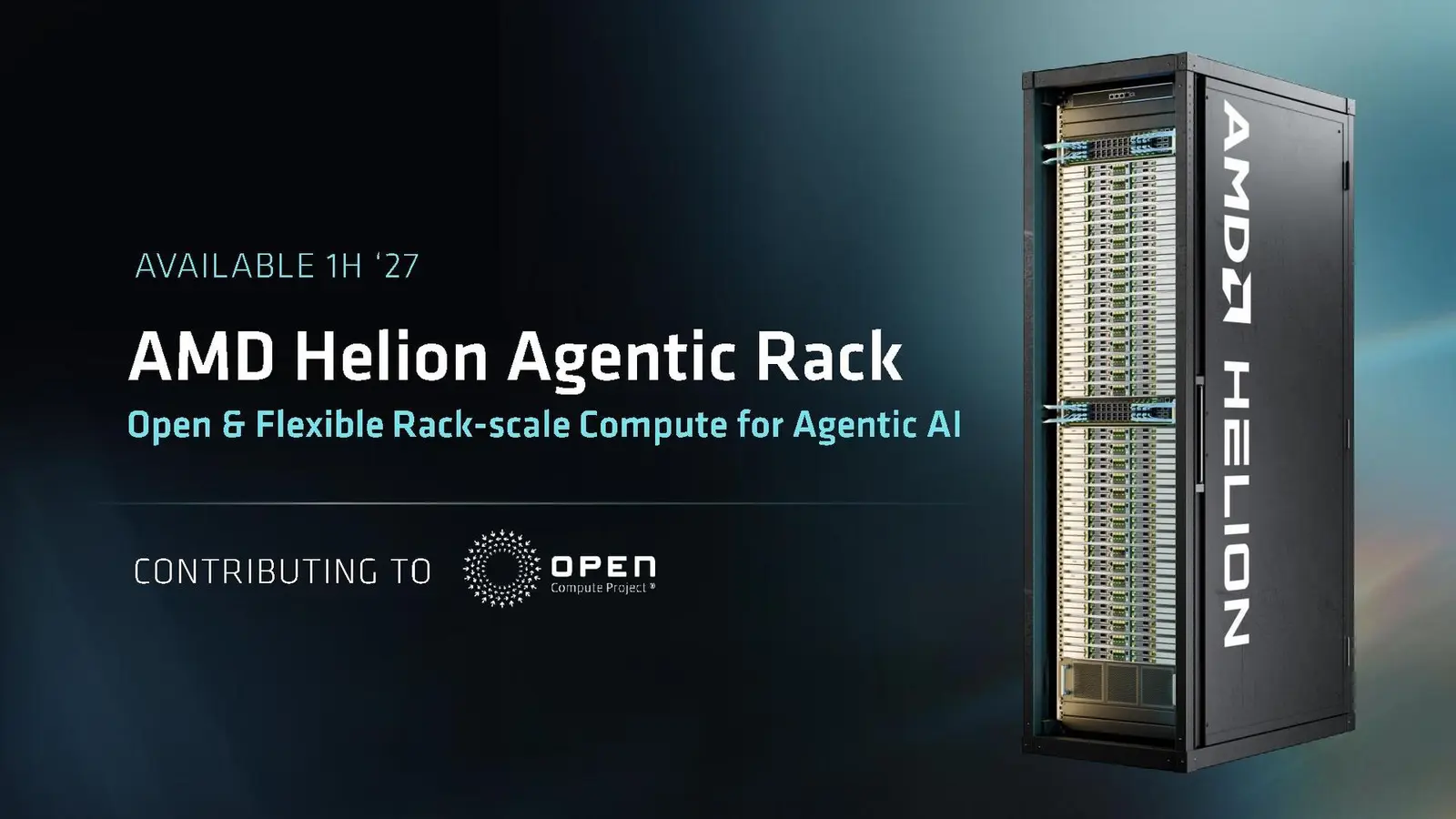
Will Helion Replace Traditional GPU‑Centric AI Servers?
At the OCP Global Summit in October, AMD unveiled Helion, a reference rack‑scale architecture aimed at agentic artificial intelligence. The design supports up to 32,768 Zen 6 „Venice” cores and will be available in CPU‑only and all‑in‑one configurations next year.
Breaking news
 Canonical’s Web Presence Hit by Second DDoS Assault This Year
 Loops AI Secures $3.5 Million to Power a New AI Operating System for E‑Commerce
 Winverse AI Secures Tens of Millions in Seed Funding from DeepSeek and Long‑Z
 Google Adds Pixel 9 Series to Certified Refurbished Store
Helion is built on AMD’s latest Zen 6 architecture, offering a massive core count that can handle the parallel processing demands of agentic AI models. The reference design uses a modular rack layout, enabling rapid deployment and scaling for data centers that need to run large‑scale AI workloads. AMD highlighted the system’s ability to manage both traditional inference tasks and the more complex, multi‑turn ## Scaling Agentic AI with Massive Core Counts AMD’s presentation emphasized that Helion’s core density is unprecedented for a rack‑scale system. By packing 32,768 Zen 6 cores into a single rack, the platform can deliver the compute throughput necessary for training and deploying sophisticated AI agents. The architecture also integrates high‑bandwidth memory and efficient interconnects, reducing latency between cores and accelerating data movement.
„Agentic AI demands both raw compute and low‑latency communication,” said an AMD spokesperson. „Helion’s design addresses both by combining a dense core array with a high‑speed fabric that keeps data moving quickly across the system.” The reference model also supports a range of accelerators, allowing customers to mix GPUs or other accelerators with the CPU cores for hybrid workloads.
Many in the industry wonder if a CPU‑centric approach can compete with GPU‑heavy architectures. AMD argues that the Zen 6 cores, coupled with its advanced memory subsystem, can match or exceed GPU performance for certain AI tasks, especially those requiring large batch sizes or fine‑tuned inference. The all‑in‑one configuration offers a turnkey solution, reducing the complexity of building a custom AI server.
What This Means for AI Infrastructure Providers
„While GPUs remain powerful, we’re showing that a well‑engineered CPU platform can deliver comparable performance for agentic AI,” the AMD engineer noted. „Helion provides a scalable, flexible path for organizations that need to run complex AI agents at scale.”
The reference design is slated for shipment next year, with OEM partners expected to release production models shortly thereafter. Early adopters will be able to test Helion in real‑world scenarios, evaluating its performance against existing GPU‑based systems.
For data center operators, Helion offers a new option in the AI hardware portfolio. Its modular rack design can fit into existing infrastructure, and the CPU‑only variant reduces power consumption compared to GPU‑heavy setups. Additionally, the all‑in‑one variant simplifies deployment, potentially lowering total cost of ownership.
Frequently Asked Questions
Industry analysts predict that Helion could attract workloads that are sensitive to power and cooling constraints, as well as those that benefit from the programmability of CPUs. If AMD’s performance claims hold, Helion may become a competitive choice for large‑scale AI services that require rapid scaling and low operational overhead.
What is the maximum core count in Helion? Helion can host up to 32,768 Zen 6 „Venice” cores in a single rack, providing massive parallel processing power for agentic AI workloads.
Will Helion work with GPUs or other accelerators? Yes, the reference design supports the addition of GPUs or other accelerators, allowing customers to create hybrid configurations tailored to specific workloads.
When will Helion be available for purchase? The reference model is expected to ship next year, with production OEM versions following shortly after.

