How Agent Usage Is Changing Daily Work Patterns
Anthropic has released an internal report detailing how its own use of AI agents is transforming workforce composition and hiring practices. Based on headcount data, agent telemetry, calendar analysis, Slack patterns, hiring scorecards, and 17 employee interviews, the study shows a significant shift in technical hiring and workflow design. The company, known for its Claude AI models, has integrated agents more deeply into its operations than most B2B firms, making this one of the most detailed self-assessments of AI’s impact on a tech workforce.
Breaking news
 Town AI Secures $108 Million Series B, Valued at $1 Billion After $55 M Pre‑Series
 Apple Prepares for Major Product Launch Event on October 28
 Apple Releases Release Candidates for watchOS, tvOS and visionOS 27.2
 Apple Limits iPhone Duo and iPhone 18 Pro Max to Reservation-Only Sales in Japan and South Korea
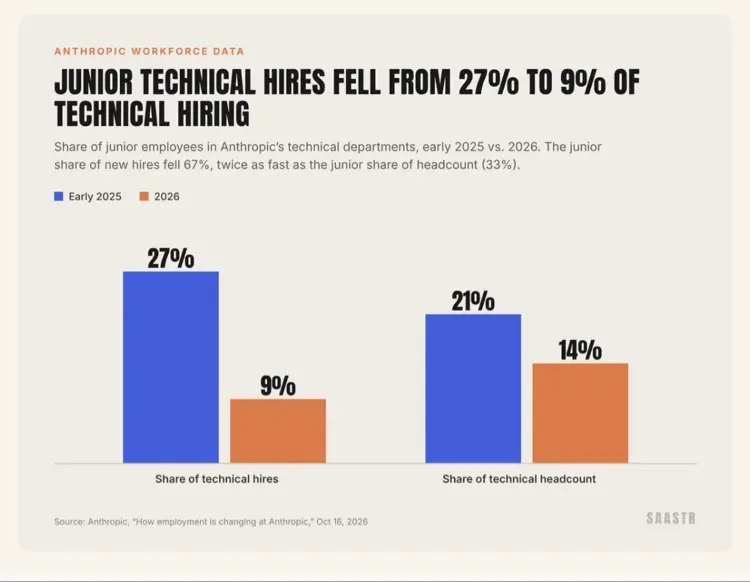
The data reveals a sharp decline in junior technical hiring, dropping from 27% of new technical roles to just 9% over the study period. Anthropic attributes this change to increased productivity from AI agents handling routine coding, testing, and documentation tasks, reducing the need for entry-level engineers. At the same time, senior technical roles have remained stable, suggesting the company is shifting toward a leaner, more experienced workforce augmented by AI. Employee interviews indicated mixed reactions, with some staff appreciating reduced mundane work while others expressed concerns about skill development and long-term career paths.
What Does This Mean for Early-Career Talent in AI Firms?
Internal telemetry showed that employees now spend an average of 3.2 hours per day interacting with AI agents, up from 1.1 hours six months prior. Calendar data revealed fewer routine meetings, as agents handle status updates and task tracking. Slack analysis indicated a 40% drop in messages related to basic troubleshooting, freeing time for higher-level design and strategy. One engineer noted in an interview that agents now draft 60% of their initial code, allowing them to focus on architecture and problem-solving. However, some reported feeling disconnected from foundational learning opportunities typically gained through hands-on debugging and incremental coding.
The reduction in junior hiring raises questions about how AI-native companies will cultivate future talent. Anthropic’s report acknowledges this tension, stating that while agents boost efficiency, they may limit exposure to foundational engineering practices. The company is exploring internal programs to pair junior staff with mentors who guide agent-assisted work, ensuring learning continues despite automation. Leaders emphasized that the goal is not to eliminate junior roles but to redefine them around AI collaboration, prompt engineering, and system oversight. The long-term effect on industry-wide hiring remains uncertain, but Anthropic’s model may influence how other AI firms structure their teams.
What caused the drop in junior technical hiring at Anthropic? The decline is linked to increased productivity from AI agents handling routine technical tasks, reducing the need for entry-level engineers while maintaining output levels.
Frequently Asked Questions
How are employees adapting to working alongside AI agents daily? Staff report spending over three hours a day with agents, using them for coding drafts and task automation, though some express concerns about missing foundational learning experiences.
Is Anthropic planning to hire more junior engineers in the future? The company is not eliminating junior roles but redefining them to focus on AI collaboration and oversight, while developing mentorship programs to support skill growth.
