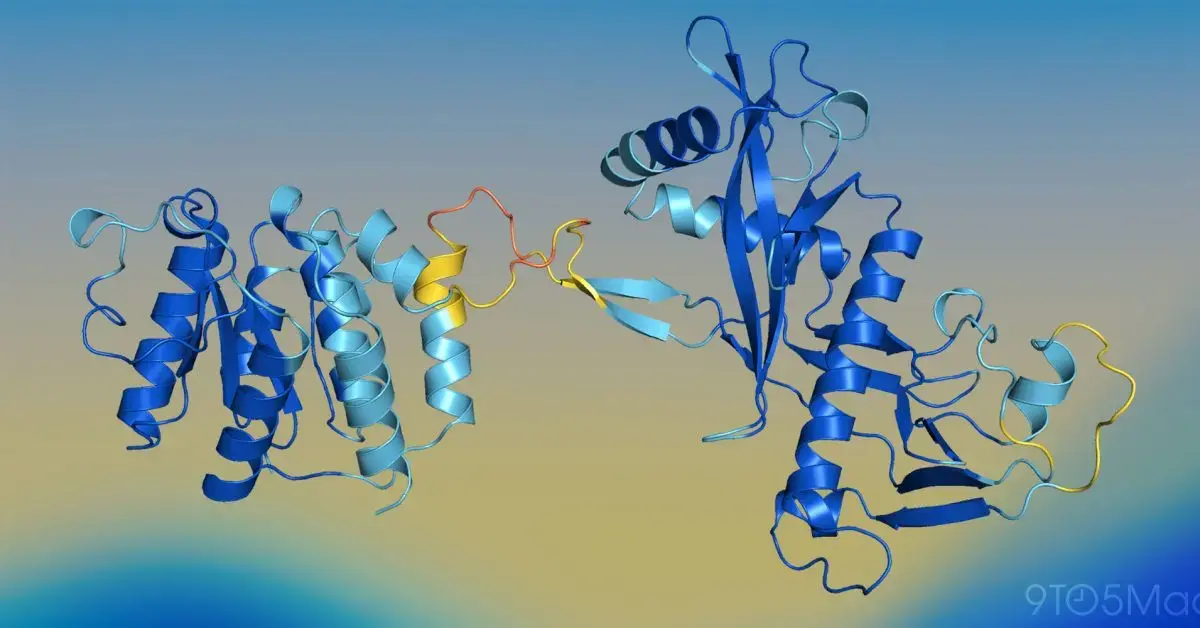
A Unified Approach to Protein Engineering
Apple's machine learning team has developed SimpleDesign, an artificial intelligence model designed to simultaneously generate both the amino acid sequences and three-dimensional structures of proteins. The research, detailed in a recent study, builds on the company's earlier work in computational biology. The team previously published findings in September 2023 under the title „SimpleFold: Folding Proteins is Simpler than You Think,”which focused on predicting protein structures using a streamlined approach.
Breaking news
 Town AI Secures $108 Million Series B, Valued at $1 Billion After $55 M Pre‑Series
 Apple Prepares for Major Product Launch Event on October 28
 Apple Releases Release Candidates for watchOS, tvOS and visionOS 27.2
 Apple Limits iPhone Duo and iPhone 18 Pro Max to Reservation-Only Sales in Japan and South Korea
Unlike traditional methods that tackle sequence prediction and structure folding as separate problems, SimpleDesign handles both tasks within a single framework. This joint generation capability could accelerate research in drug discovery, enzyme engineering, and synthetic biology. The model leverages insights from the earlier SimpleFold work, which demonstrated that protein folding could be approached with greater simplicity than previously assumed. By combining sequence and structure generation, SimpleDesign aims to reduce computational overhead while improving accuracy in designing novel proteins with specific functions.
What Makes SimpleDesign Different from Existing Tools?
The key innovation lies in SimpleDesign's ability to produce coherent protein designs without requiring iterative refinement between separate sequence and structure models. Traditional pipelines often involve multiple steps—predicting a structure, then optimizing the sequence, then re-predicting the structure. SimpleDesign collapses this process into one integrated step, potentially saving researchers significant time and computing resources. Early results suggest the model performs well on benchmark protein design challenges, though the study did not include large-scale experimental validation data.
Looking ahead, Apple's research team plans to expand SimpleDesign's capabilities by incorporating more complex biological constraints and testing its performance on real-world protein engineering projects. If successful, the technology could find applications in personalized medicine, agricultural biotechnology, and industrial enzyme production. The researchers also hope to collaborate with academic institutions and pharmaceutical companies to further refine the model. As AI continues to reshape biological research, tools like SimpleDesign may help bridge the gap between computational predictions and laboratory experiments, bringing us closer to programmable biology.
What is SimpleDesign and who developed it? SimpleDesign is an AI model created by Apple researchers that can generate both protein sequences and their 3D structures simultaneously. It represents the company's ongoing expansion into computational biology and machine learning applications beyond consumer technology.
Frequently Asked Questions
How does SimpleDesign improve upon previous methods? The model integrates sequence and structure generation into a single process, eliminating the need for multiple separate steps. This unified approach reduces computational complexity and may speed up protein design workflows compared to traditional iterative methods.
What are the potential applications of this technology? SimpleDesign could support drug discovery, enzyme engineering, and synthetic biology research. The researchers envision collaborations with academic and pharmaceutical partners to apply the model to real-world biological challenges, though further validation is needed.
