How Does This Workstation Compare to Traditional AI Infrastructure?
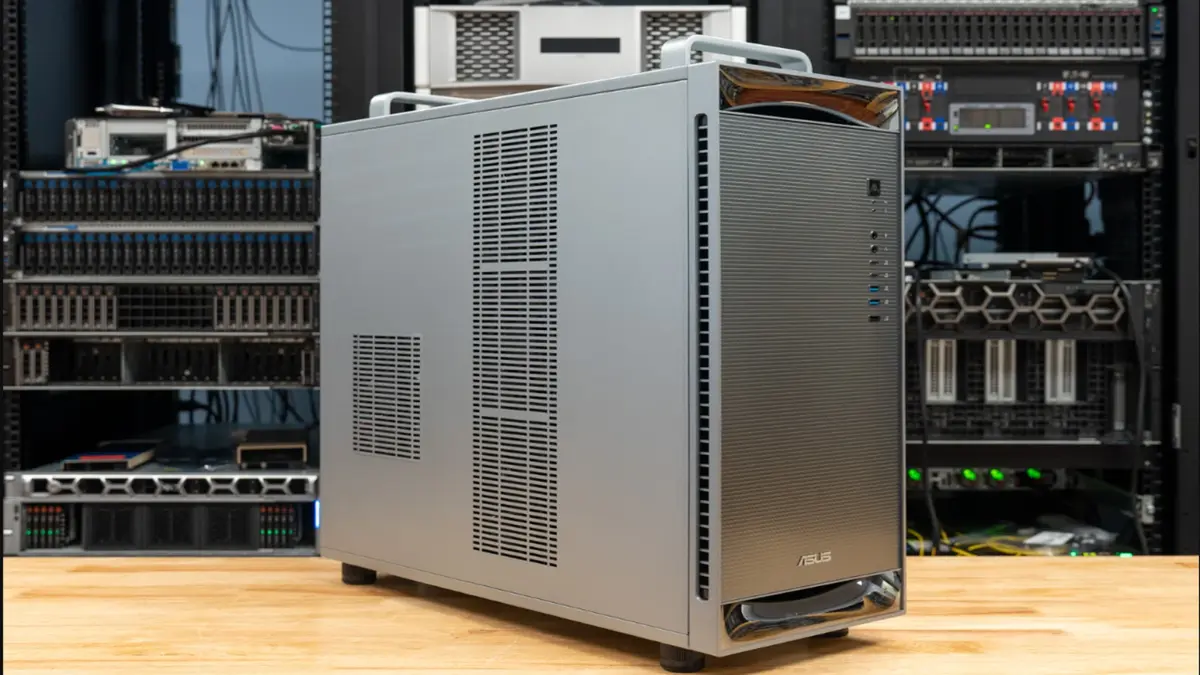
ASUS has launched the GB300 DGX workstation, positioning it as a high-performance desktop system inspired by the iconic Apple Mac Pro, with reviewers praising its ability to handle intensive AI workloads directly from a desk. The system, unveiled in late September 2026, delivers data center-grade computing power in a compact form factor, targeting professionals in AI development, machine learning, and complex simulation fields. Early assessments highlight its dual configuration capability, enabling two units to pool nearly 1.5 terabytes of shared memory for extreme multitasking and large-scale model training.
Breaking news
 Town AI Secures $108 Million Series B, Valued at $1 Billion After $55 M Pre‑Series
 Apple Prepares for Major Product Launch Event on October 28
 Apple Releases Release Candidates for watchOS, tvOS and visionOS 27.2
 Apple Limits iPhone Duo and iPhone 18 Pro Max to Reservation-Only Sales in Japan and South Korea
The GB300 DGX integrates NVIDIA’s DGX architecture with ASUS’s engineering, combining server-level GPUs, high-speed interconnects, and expanded memory bandwidth into a workstation chassis. Unlike traditional rack-mounted AI systems, this design allows deployment in office environments without requiring specialized cooling or power infrastructure. Reviewers note that running dozens of AI agents simultaneously is now feasible on a single desk, a feat previously limited to cluster setups. The $120,000 price point reflects its positioning as a premium tool for enterprise AI teams needing immediate, localized access to massive computational resources.
What Are the Implications for AI Development Workflows?
While conventional AI training relies on remote data centers or cloud platforms, the GB300 DGX brings comparable performance on-premises, reducing latency and enhancing data security for sensitive projects. Its architecture supports NVLink interconnects and scalable memory configurations, allowing seamless collaboration between dual units. This setup mimics the distributed processing of larger systems but maintains a footprint suitable for professional workspaces. The workstation’s ability to sustain heavy AI workloads without thermal throttling has been highlighted as a key advancement over prior-generation desktop solutions.
By enabling localized execution of large language models and multimodal AI systems, the GB300 DGX could accelerate prototyping and iteration cycles for research teams. Developers gain immediate feedback loops without queuing for cloud resources or managing remote infrastructure. This shift may particularly benefit industries like healthcare, autonomous systems, and financial modeling, where data privacy and real-time processing are critical. The workstation also signals a trend toward bridging the gap between hyperscale computing and accessible desktop tools, potentially reshaping how organizations allocate AI resources.
What makes the GB300 DGX suitable for desk-side use despite its power? It integrates server-grade components into a thermally optimized chassis designed for office environments, eliminating the need for data center-level cooling or power setups while maintaining performance.
Frequently Asked Questions
Can two GB300 units truly share 1.5 TB of memory? Yes, when configured in a linked pair, the workstations utilize high-bandwidth interconnects to pool memory resources, enabling unified access across both systems for large-scale AI tasks.
Who is the primary target audience for this workstation? It is aimed at enterprise AI researchers, machine learning engineers, and technical professionals requiring on-premises, high-capacity computing for model training, inference, and simulation without relying on external cloud services.
