Salesforce’s Valuation Still Holds at 3.1× ARR
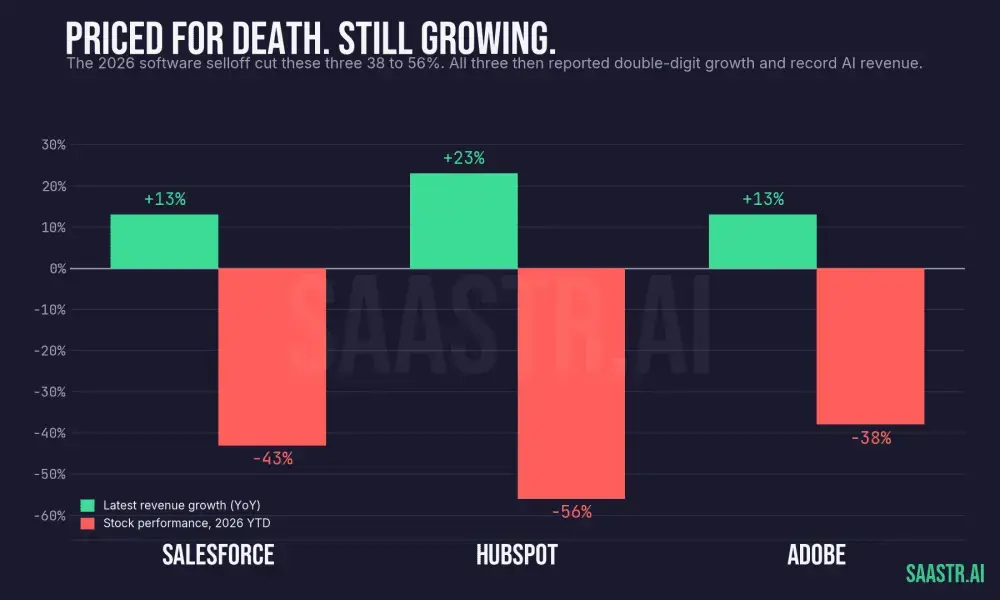
Four months ago, investors declared B2B software dead. In a 48‑hour burst in February, roughly $285 billion of software market cap vanished. The panic stemmed from fears that AI agents would render per‑seat licensing obsolete, threatening the core revenue model of many enterprise vendors.
Breaking news
 Town AI Secures $108 Million Series B, Valued at $1 Billion After $55 M Pre‑Series
 Apple Prepares for Major Product Launch Event on October 28
 Apple Releases Release Candidates for watchOS, tvOS and visionOS 27.2
 Apple Limits iPhone Duo and iPhone 18 Pro Max to Reservation-Only Sales in Japan and South Korea
The sell‑off was swift and brutal, but it also set the stage for a rapid reassessment of valuations. Analysts now argue that the market overreacted, leaving several high‑growth companies undervalued. With AI tools proving complementary rather than destructive, investors are revisiting price‑to‑sales and price‑to‑earnings multiples to gauge true upside.
Salesforce remains anchored at a 3.1‑times annual recurring revenue multiple, a figure that signals confidence in its subscription engine. Despite the broader market dip, the cloud giant’s ARR grew 18 % year‑over‑year, driven by expanding footprints in sales, service, and marketing clouds. Executives point to a robust pipeline of AI‑enhanced products that deepen customer stickiness. „Our AI‑driven Einstein suite is still early in its adoption curve, and we expect it to lift revenue per seat over the next two years,” a senior Salesforce officer told analysts.
Is HubSpot’s 56% Drop a Sign of a Deeper Correction?
Investors have also praised Salesforce’s disciplined spending, noting that operating margins improved marginally even as the company invested heavily in generative AI research. The combination of steady growth and disciplined capital allocation has kept the stock’s valuation relatively stable, even as peers slipped.
HubSpot’s market cap plunged 56 % after the February shock, raising questions about whether the decline reflects a temporary panic or a fundamental overvaluation. The marketing automation platform reported a 12 % slowdown in new ARR growth, a figure that fell short of analysts’ expectations. Critics argue that HubSpot’s reliance on small‑business customers makes it vulnerable to budget cuts during economic uncertainty.
Company leadership counters that the dip is a market overreaction to short‑term metrics. „Our product roadmap includes AI‑powered content creation tools that will unlock new revenue streams,” the CEO said in a recent earnings call. Nonetheless, the sharp price swing has left investors cautious, and many are waiting for the next quarterly report to assess whether the company can regain momentum.
The fallout from the February sell‑off may reshape the B2B software landscape. Companies with solid AI integration plans and disciplined financials appear better positioned to weather volatility. As the market digests the initial shock, analysts expect a gradual return to more rational pricing, with upside potential for firms that can demonstrate sustainable AI‑driven growth.
Frequently Asked Questions
Why did AI fears trigger such a massive market decline? Investors worried that generative AI could replace human users, making per‑seat licensing obsolete and threatening the revenue model of many SaaS firms.
Is Salesforce’s 3.1× ARR multiple considered high? Compared with the broader software sector, the multiple is modest, reflecting confidence in Salesforce’s recurring revenue base and AI‑enhanced product suite.
Will HubSpot recover its lost valuation? Recovery depends on the company’s ability to accelerate AI adoption and broaden its enterprise customer base, which could restore investor confidence over the next year.