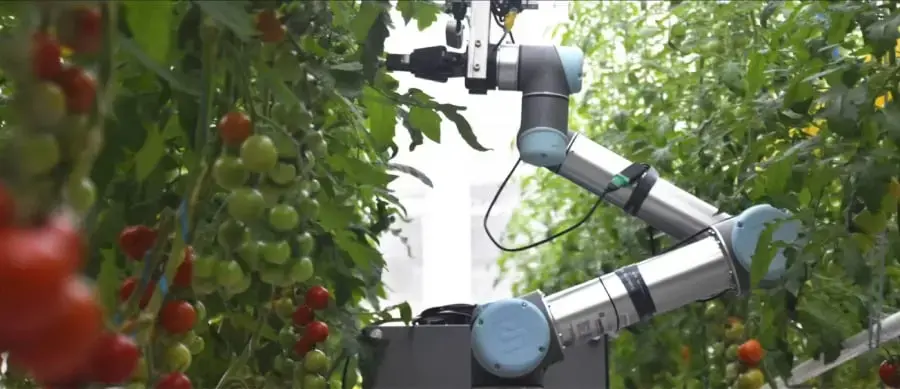
The robot can work continuously for up to six hours on a single battery charge
China’s GEAIR 2.0 humanoid robot has demonstrated the ability to pollinate tomato flowers in under ten seconds during recent trials in greenhouse facilities. The system combines artificial intelligence with precision robotics to identify and treat individual blossoms rapidly. Developed by a Chinese agricultural technology firm, the robot operates autonomously in controlled environments, targeting crops that require manual pollination due to declining bee populations or greenhouse isolation. The demonstration took place in a research greenhouse facility in eastern China, where scientists monitored performance across multiple tomato varieties. The GEAIR 2.0 uses computer vision to detect flower maturity and position, then employs a soft-tipped mechanical arm to transfer pollen without damaging the plant. Unlike earlier models, this version integrates real-time feedback loops that adjust pressure and angle based on flower response. Engineers report a success rate exceeding 90% in test runs, with each pollination cycle completed in an average of 8.7 seconds.
Breaking news
 Town AI Secures $108 Million Series B, Valued at $1 Billion After $55 M Pre‑Series
 Apple Prepares for Major Product Launch Event on October 28
 Apple Releases Release Candidates for watchOS, tvOS and visionOS 27.2
 Apple Limits iPhone Duo and iPhone 18 Pro Max to Reservation-Only Sales in Japan and South Korea
The robot can work continuously for up to six hours on a single battery charge, covering approximately 1,200 plants per hour. Developers emphasize that the system reduces labor costs and increases yield consistency compared to manual methods, which are slow and physically demanding. How Does the Robot Adapt to Different Flower Types? The GEAIR 2.0’s AI model was trained on thousands of images of tomato flowers at various growth stages, enabling it to distinguish between receptive and non-receptive blooms. It adjusts its approach based on petal openness and pollen availability, avoiding wasted effort on immature or already pollinated flowers. This adaptive capability allows the robot to maintain high efficiency even in mixed-crop greenhouses where flower development varies. Field technicians noted that the system requires minimal recalibration when switching between tomato cultivars, suggesting broad applicability within the Solanaceae family.
The robot’s software updates remotely, allowing improvements to be deployed
The robot’s software updates remotely, allowing improvements to be deployed across units without physical intervention. What Are the Limits of Current Pollination Robots? While effective for tomatoes, the GEAIR 2.0’s current design is not suited for crops with complex flower structures like kiwi or almond, which require different pollen transfer techniques. The robot also functions best in stable indoor environments; outdoor use remains challenging due to wind, light variability, and unpredictable insect interference. Battery life and mobility on uneven terrain are additional constraints being addressed in next-generation prototypes. Scientists caution that robotic pollination should complement, not replace, natural pollinators where ecosystems support them. However, in regions facing severe pollinator decline or in vertical farms where bees cannot operate, such technology offers a viable alternative to safeguard food production. Frequently Asked Questions How long does the GEAIR 2.0 take to pollinate one tomato flower?
On average, the robot completes each pollination in 8.7 seconds, with a success rate over 90% in controlled trials. Can the robot be used outside greenhouses? Not effectively yet; outdoor conditions like wind and variable light interfere with its vision and precision systems. Is the technology intended to replace bees? No, developers state it is designed to assist in environments where natural pollination is insufficient or impossible, not to eliminate reliance on bees where they thrive.
