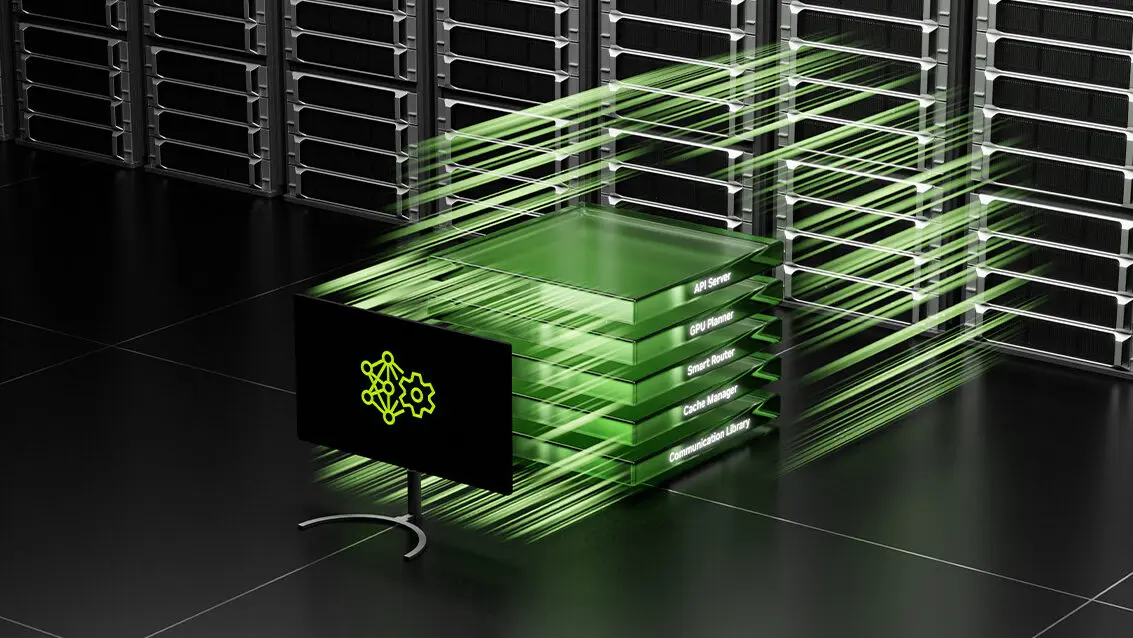
How Topograph Redefines Workload Placement
NVIDIA unveiled Topograph, a new tool that places GPU workloads based on system topology, aiming to boost efficiency in power‑constrained AI data centers. The technology targets large‑scale AI factories where every watt counts, promising higher throughput and lower operational costs by reducing unnecessary data movement across shared interconnects.
Breaking news
 Canonical’s Web Presence Hit by Second DDoS Assault This Year
 Loops AI Secures $3.5 Million to Power a New AI Operating System for E‑Commerce
 Winverse AI Secures Tens of Millions in Seed Funding from DeepSeek and Long‑Z
 Google Adds Pixel 9 Series to Certified Refurbished Store
Topograph analyzes the physical layout of GPUs, memory, and network links, then assigns tasks to minimize traffic that would otherwise traverse bottlenecked pathways. By keeping compute and data close together, the system avoids fragmenting topology domains—a common cause of idle GPUs waiting for data. Early tests show up to a 20 % increase in job completion speed and a noticeable drop in power waste, as GPUs spend less time idle while data queues clear.
The core of Topograph’s approach lies in its topology‑aware scheduler, which maps each AI workload to the most suitable GPU cluster within a server rack. Unlike traditional schedulers that focus solely on load balance, Topograph evaluates link bandwidth, latency, and power budgets in real time. „We realized that simply spreading jobs evenly doesn’t guarantee optimal performance,” said Dr. Maya Patel, senior engineer at NVIDIA. „When workloads are scattered across distant GPUs, the interconnect becomes a choke point, throttling overall throughput.”
Can Topology‑Aware Scheduling Solve the Power Bottleneck?
By consolidating related tasks on neighboring GPUs, Topograph reduces cross‑rack traffic, freeing up shared links for other operations. The tool also integrates with existing orchestration platforms, allowing data center operators to adopt it without overhauling their infrastructure. In benchmark environments, the scheduler cut average job latency by 15 % and lowered power consumption per inference by roughly 10 %, translating into tangible cost savings for enterprises running continuous AI services.
Power limits have become a critical constraint as AI models grow larger and demand more compute. Topograph addresses this by ensuring that GPUs are not left idling while awaiting data, a scenario that wastes provisioned power without delivering work. The scheduler’s real‑time adjustments keep the hardware operating near its optimal efficiency point, preventing scenarios where a GPU consumes its full power allocation but makes no progress.
Industry analysts note that such intelligent placement could become a standard practice as data centers strive for sustainability. „If you can shave even a few percent off power use across thousands of GPUs, the environmental impact is significant,” observed Laura Kim, a cloud infrastructure analyst. The technology also positions NVIDIA as a leader in providing not just raw compute power but also the software intelligence needed to harness it effectively.
The rollout of Topograph is expected to begin later this year, with pilot programs already underway in several hyperscale facilities. As AI workloads continue to dominate compute cycles, tools that align compute with the underlying hardware topology will be essential for maintaining performance while respecting power ceilings.
Frequently Asked Questions
What is the main benefit of Topograph’s topology‑aware scheduling? It aligns AI workloads with the physical layout of GPUs and interconnects, reducing data movement, cutting latency, and lowering power waste.
Will existing AI workloads need to be rewritten to use Topograph? No. Topograph integrates with current orchestration systems, allowing workloads to run unchanged while the scheduler optimizes placement behind the scenes.
How soon can data centers expect to see these efficiency gains? Pilot deployments are already delivering results, and broader availability is slated for the fourth quarter, with measurable improvements expected within weeks of adoption.

