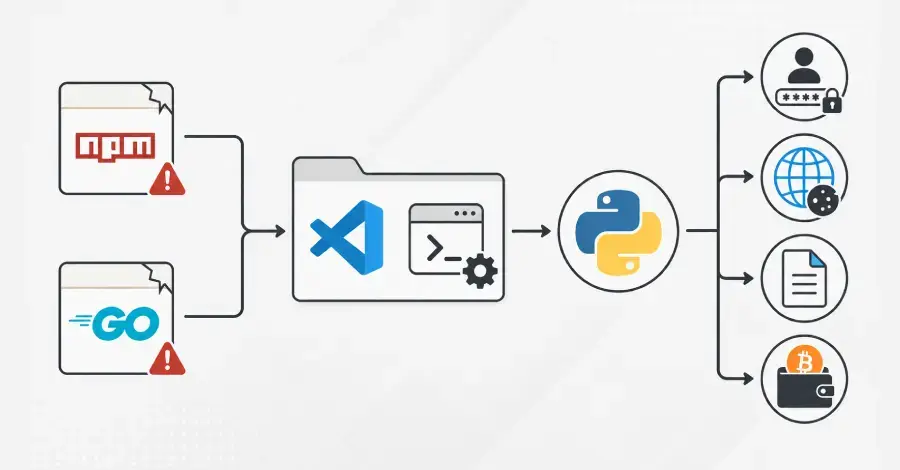
How the VS Code Task Chain Evades Traditional Defenses
Cybersecurity researchers disclosed on June 29, 2026 that two npm modules and a group of Go libraries have been compromised to deliver a Python‑based information stealer. The malicious code targets Windows, Linux and macOS machines, leveraging Visual Studio Code tasks to run unnoticed on infected hosts.
Breaking news
 Eufy Unveils Local AI Home Security Ecosystem at IFA
 The Rapid Evolution of Data Center Security in the AI Era
 The High-Voltage Risks Facing Modern AI Data Centers
 Apple’s New CEO Renames Lake Ontario To Lake America In Maps App
The attackers sidestepped typical npm lifecycle scripts, which most defenses monitor, by embedding a VS Code task definition inside the package metadata. When a developer opens the compromised project in VS Code, the editor automatically executes the hidden task, pulling a Python payload that harvests credentials, browser data and cryptocurrency wallets. The Go packages act as a delivery network, fetching the same payload from remote servers and spreading it across different development environments. Researchers say the operation reflects a sophisticated supply‑chain strategy aimed at exploiting the trust developers place in open‑source components.
The malicious npm packages contain a `tasks.json` file that VS Code reads on project load. This file defines a custom task that runs a Python script without user interaction. Because the task is triggered by the editor rather than by an npm install script, many security tools miss the execution. „We observed the task launching silently, bypassing npm’s usual hook checks,” one analyst explained. The Python stealer then contacts command‑and‑control servers to download additional modules, encrypting harvested data before exfiltration. The Go packages, published under popular namespaces, include code that programmatically creates the same `tasks.json` file, ensuring the attack spreads even when developers replace the npm modules with fresh copies.
Why Are Go Packages Becoming a Preferred Vector?
Go’s rapid growth and its reliance on public module mirrors make it an attractive target for attackers. Unlike npm, Go modules are often fetched directly from source control without checksum verification, allowing malicious code to slip through. The researchers noted a pattern: the compromised Go libraries all reference the same external repository, which serves the Python payload. „The convergence of Go’s module system and VS Code’s task automation gives threat actors a low‑profile delivery channel,” the report said. By chaining npm, Go and VS Code, the campaign achieves cross‑platform reach while remaining invisible to many conventional scanning tools.
The breach underscores the need for developers to scrutinize every dependency, even those that appear benign. Organizations should enforce strict code‑review policies for third‑party modules and consider disabling automatic task execution in VS Code. As supply‑chain attacks grow more intricate, the security community expects similar multi‑language tactics to surface, demanding broader awareness and tighter controls.
Frequently Asked Questions
What platforms are affected by the Python stealer? The payload runs on Windows, Linux and macOS, allowing attackers to harvest data from a wide range of development machines.
Can disabling VS Code tasks prevent the infection? Turning off automatic task execution blocks the initial trigger, but attackers may still use alternative methods, so comprehensive dependency checks are essential.
How can developers verify the integrity of npm and Go packages? Using lockfiles, checksum verification, and manual code reviews for new or updated dependencies helps detect tampering before malicious code executes.