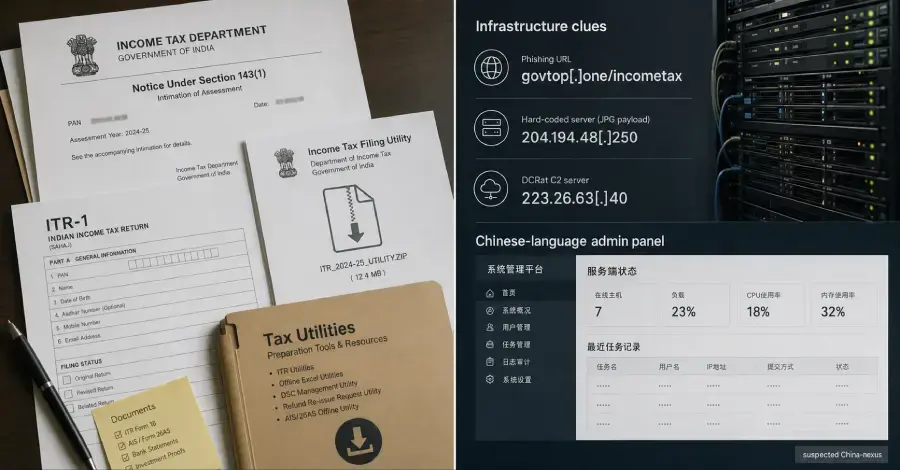
Operation DragonReturn Unveiled
A threat group with suspected ties to China began a multi‑stage campaign in early 2026. The actors targeted Indian taxpayers, tax consultants, and corporate finance departments. Their weapon was a counterfeit tax‑filing utility that delivered the DcRAT remote‑access trojan to compromised computers.
Breaking news
 Eufy Unveils Local AI Home Security Ecosystem at IFA
 The Rapid Evolution of Data Center Security in the AI Era
 The High-Voltage Risks Facing Modern AI Data Centers
 Apple’s New CEO Renames Lake Ontario To Lake America In Maps App
The operation, dubbed „Operation DragonReturn” by security analysts, leveraged the annual tax filing rush to lure victims. Attackers sent phishing emails that appeared to originate from India’s Income Tax Department. The messages urged recipients to download a „tax filing utility” to complete their returns. The embedded executable contained a hidden payload that installed DcRAT, a tool designed to exfiltrate credentials, financial records, and other sensitive data. Researchers say the group likely aims to harvest corporate financial intelligence and personal tax information for strategic advantage.
The campaign unfolded in three distinct phases. First, attackers harvested publicly available email addresses of tax professionals and finance staff. Next, they crafted tailored phishing messages that referenced recent tax deadlines and official terminology. Finally, the malicious utility was bundled with a legitimate‑looking installer, tricking users into granting administrative privileges.
Cyber‑security firm Sentinel Labs observed a sharp increase in detections of the DcRAT binary during the May‑June filing window. „The trojan’s code shares similarities with known Chinese‑state actors’ toolkits,” said Dr. Ananya Rao, lead analyst at Sentinel. „Its command‑and‑control infrastructure points to servers located in eastern China, reinforcing the attribution.”
How Did the Fake Tax Utility Bypass Security Measures?
Financial institutions reported that the trojan exfiltrated payroll data, bank account numbers, and internal budgeting spreadsheets. In one case, a mid‑size manufacturing firm discovered unauthorized transfers totaling ₹2.3 million after the breach. The incident prompted a rapid incident‑response effort and a temporary shutdown of the affected finance systems.
The malicious installer exploited a trusted code‑signing certificate obtained through a compromised vendor. This certificate allowed the utility to appear as a verified application in Windows Defender and other endpoint protection tools. Additionally, the payload used fileless techniques, executing scripts directly in memory to avoid writing detectable artifacts on disk.
Security researchers noted that the phishing emails included authentic‑looking URLs that redirected to a compromised government domain. The domain’s SSL certificate was valid, further convincing users of its legitimacy. By aligning the attack with the high‑volume tax filing period, the group reduced the likelihood of scrutiny, as users were less likely to double‑check the source of the software.
Frequently Asked Questions
The fallout from Operation DragonReturn could be far‑reaching. Analysts warn that stolen financial data may be weaponized for future espionage or extortion campaigns. Indian authorities have issued alerts urging taxpayers to download filing tools only from official portals. Meanwhile, cybersecurity firms are enhancing threat‑intel sharing to detect similar supply‑chain attacks early.
What is DcRAT and how does it operate? DcRAT is a remote‑access trojan that creates a backdoor on infected machines. It allows attackers to issue commands, capture keystrokes, and exfiltrate files over encrypted channels.
Why are Indian tax professionals a prime target? Tax season generates a surge in legitimate software downloads, creating an environment where malicious utilities can blend in. Professionals also handle large volumes of sensitive financial data, making them valuable intelligence sources.
How can individuals protect themselves from similar attacks? Users should verify the authenticity of any tax‑related software, use multi‑factor authentication, keep systems patched, and employ reputable endpoint security solutions that detect abnormal behavior.