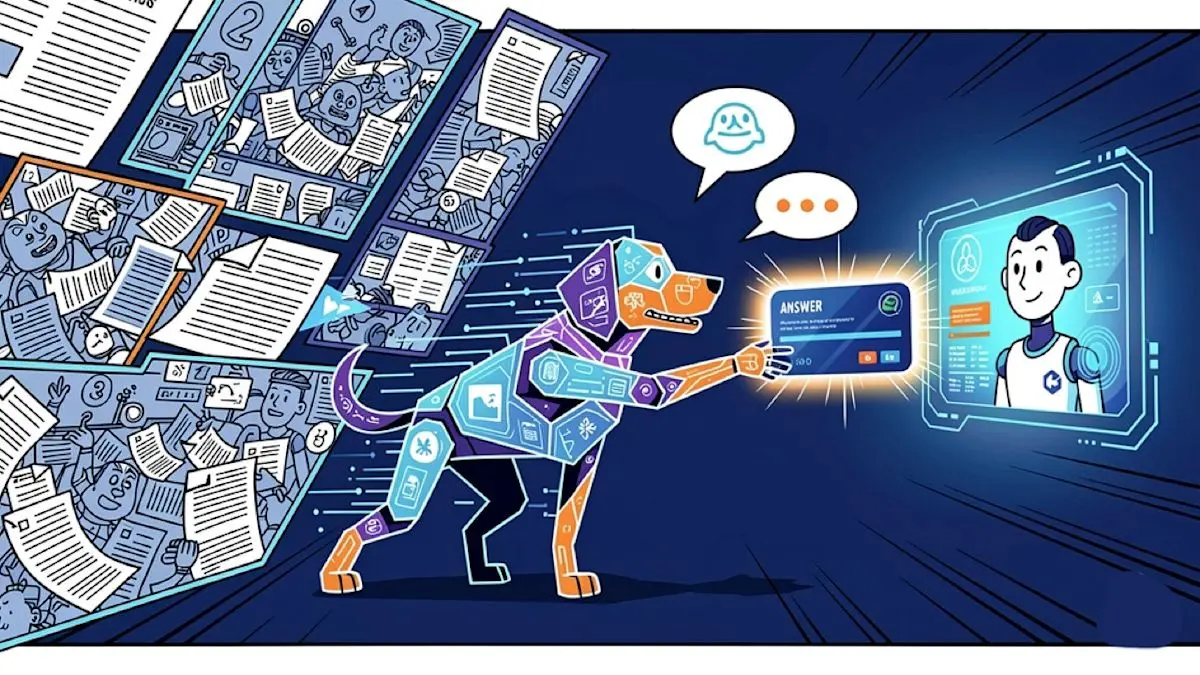
Optimizing Search Depth Without Sacrificing Accuracy
New benchmarks reveal that AI agents trained by Databricks achieve answer quality comparable to leading models like Claude and GPT-5.6. These specialized systems deliver results in approximately half the time required by their larger counterparts. The findings challenge the assumption that massive model size is necessary for high-accuracy document retrieval tasks. This efficiency gain could significantly reduce operational costs for enterprises relying on agentic workflows.
Breaking news
 Canonical’s Web Presence Hit by Second DDoS Assault This Year
 Loops AI Secures $3.5 Million to Power a New AI Operating System for E‑Commerce
 Winverse AI Secures Tens of Millions in Seed Funding from DeepSeek and Long‑Z
 Google Adds Pixel 9 Series to Certified Refurbished Store
The core challenge in agentic search lies in determining when to stop searching. Most current tools face a binary dilemma regarding search duration. If an agent stops too early, it often misses complex questions requiring multi-hop Conversely, if the agent continues searching indefinitely, it wastes resources by repeating steps on simple queries. This inefficiency creates a trade-off between thoroughness and speed that has plagued the field for years.
Databricks addressed this issue by training agents to dynamically adjust their search depth. Instead of using a fixed number of iterations, these models learn to recognize when sufficient evidence has been gathered. They evaluate the confidence of their internal This adaptive approach allows the system to handle simple factual questions quickly while dedicating more computational power to complex inquiries. The result is a streamlined process that avoids unnecessary loops without skipping critical verification steps.
Can Smaller Agents Outperform Larger Models?
The technology relies on reinforcement learning techniques tailored specifically for retrieval-augmented generation. By simulating thousands of search scenarios, the agents develop intuition about information density. They learn which types of queries typically require extensive cross-referencing versus those that can be resolved with single-document checks. This method reduces the average number of tool calls per query. Consequently, the total latency drops significantly compared to static rule-based systems.
The performance gap between these optimized agents and frontier models has narrowed considerably. In blind testing, users struggled to distinguish answers generated by the Databricks-trained agents from those produced by Claude or GPT-5.6. The accuracy scores remained statistically similar across diverse document corpora. However, the time-to-answer metric showed a dramatic difference. The smaller, specialized agents completed tasks roughly twice as fast. This speed advantage becomes crucial in real-time applications where user experience depends on immediate feedback.
Frequently Asked Questions
Industry experts suggest that this shift favors efficiency over raw scale. Companies can deploy more agents simultaneously without proportional increases in infrastructure costs. The reduced latency enables richer interactive experiences in customer support and knowledge management systems. As inference costs remain a primary concern for AI adoption, these results offer a compelling alternative to running the largest available models for every task.
How does the dynamic search mechanism work? The agent uses learned heuristics to assess confidence levels after each search step. It terminates the loop only when the probability of finding new relevant information drops below a specific threshold.
What types of documents do these agents handle best? The benchmarks focused on structured and semi-structured corporate data sets. The technology performs well when documents contain clear entities and relationships that facilitate multi-hop

