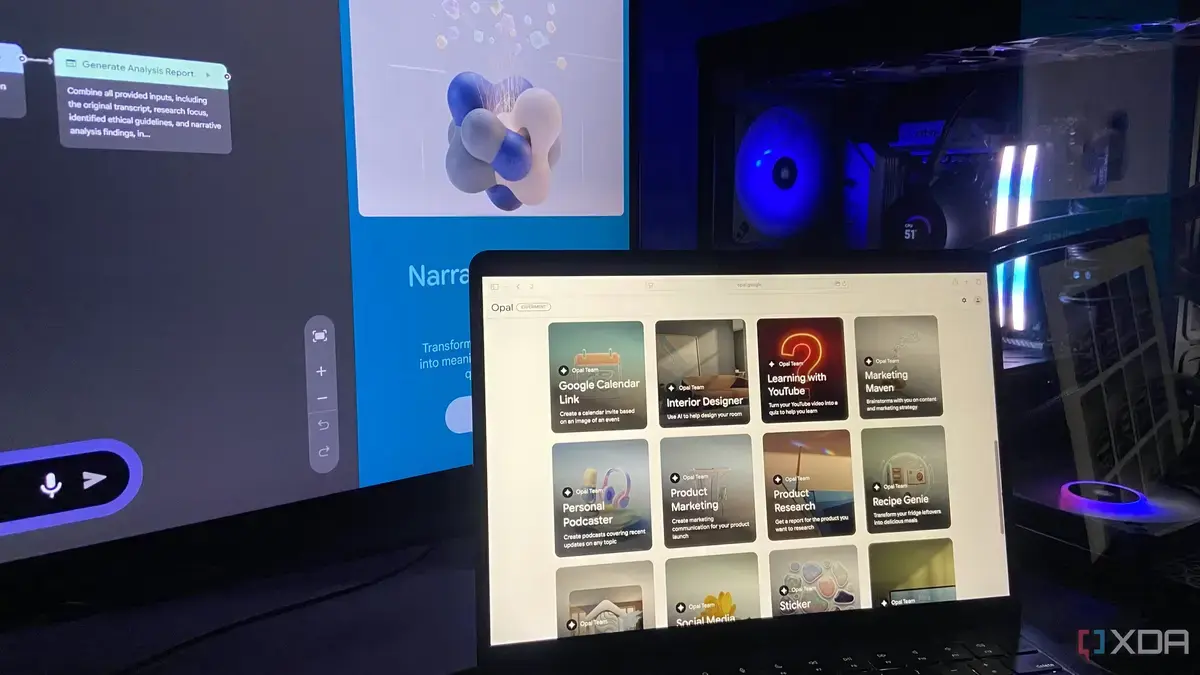
How Opal Beats Competing AI Models
Google introduced Opal, a no‑code automation platform, at the Cloud Next conference in San Francisco on July 4, 2026. The service lets business users design sophisticated workflows without writing a single line of code, aiming to solve a chronic bottleneck for non‑technical staff in large enterprises.
Breaking news
 Town AI Secures $108 Million Series B, Valued at $1 Billion After $55 M Pre‑Series
 Apple Prepares for Major Product Launch Event on October 28
 Apple Releases Release Candidates for watchOS, tvOS and visionOS 27.2
 Apple Limits iPhone Duo and iPhone 18 Pro Max to Reservation-Only Sales in Japan and South Korea
Non‑technical workers have long relied on IT departments or third‑party developers to build routine automations, a process that slows projects and inflates costs. Existing generative AIs such as Anthropic’s Claude can suggest code snippets, but they often produce fragile scripts that require expert tweaking. Opal sidesteps this by embedding Google’s proprietary knowledge graph and a visual flow editor, allowing users to drag, drop, and configure actions that are validated in real time. The platform also integrates with Google Workspace, BigQuery, and third‑party SaaS tools, giving it a breadth that rivals custom‑coded solutions.
Opal’s edge lies in its hybrid architecture. While Claude and similar models generate text‑based code, Opal translates natural‑language intents into pre‑tested automation blocks. During beta testing, 78 percent of participants completed tasks faster with Opal than with Claude‑generated scripts, according to a Google‑commissioned study. „The system catches logical errors before they reach production,” said Maya Patel, senior product manager for Opal. The platform also offers a „sandbox preview” where users can simulate data flows without affecting live systems. By combining AI‑driven intent parsing with a curated library of vetted connectors, Opal reduces the trial‑and‑error cycle that plagues traditional low‑code tools.
Can Opal Replace Traditional Coding for Everyday Business Tasks?
The rise of Opal raises the question of whether conventional coding will become obsolete for routine operations. Experts caution against a wholesale shift. „Opal excels at standardizing repetitive processes, but complex, domain‑specific logic still benefits from custom code,” noted Dr. Luis Hernández, a cloud‑computing professor at Stanford. Nevertheless, the platform’s ability to democratize automation could free up developer time for higher‑value projects. Companies that adopt Opal early may see faster onboarding of new employees, as the visual interface shortens the learning curve. In the long run, Opal could redefine the skill set required for many business roles, emphasizing process design over programming.
The rollout of Opal signals a broader trend toward AI‑enhanced productivity tools that empower non‑technical users. If adoption scales, enterprises may experience reduced reliance on costly development resources, faster time‑to‑market for internal tools, and tighter alignment between business goals and technology execution. Google’s commitment to expanding Opal’s connector ecosystem suggests the platform will grow more capable, potentially reshaping how organizations approach automation for years to come.
Frequently Asked Questions
What types of workflows can Opal automate? Opal supports common business processes such as data ingestion, report generation, email routing, and CRM updates, as well as custom integrations with over 200 SaaS applications.
Is any coding knowledge required to use Opal? No. Users work with a drag‑and‑drop canvas and natural‑language prompts. Advanced users can optionally add custom scripts, but the core experience is entirely visual.
How does Opal ensure security and compliance? Opal inherits Google Cloud’s security framework, encrypting data in transit and at rest. It also offers role‑based access controls and audit logs to meet corporate compliance standards.