Managing the Bottlenecks of Orchestration
Modern artificial intelligence is shifting toward agentic systems that perform complex, multi-step tasks independently. As these agents move beyond simple queries, the burden on CPU performance grows significantly. Developers must now rethink how hardware and software stacks interact to handle the heavy orchestration required for autonomous digital workflows.
Breaking news
 AI Models Can Be Easily Modified to Assist Terrorist and Extremist Activity
 The New Era of Autonomous Software Engineering
 Qualcomm Wins Legal Battle Against Arm But Award Is Minimal
 The Illusion of AI Expertise Among Men
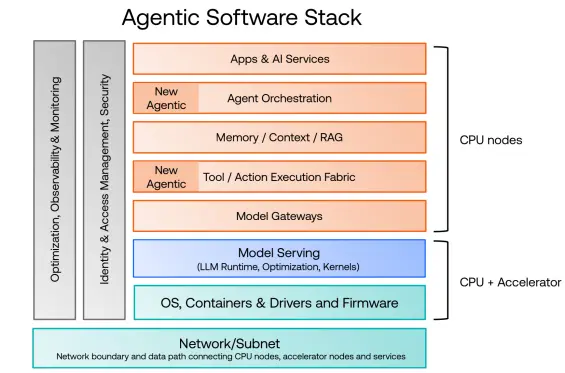
Agentic AI operates through iterative cycles rather than single-pass computations. A typical task involves continuous model calls, real-time data retrieval, and complex state management. While specialized accelerators handle the heavy lifting of model execution, the CPU acts as the central nervous system. It manages tool execution, policy validation, and application interactions throughout the entire process.
The efficiency of an agent is often limited by the latency between these diverse operational steps. If the CPU cannot coordinate tool calls and validation loops quickly, the high-speed processing of accelerators becomes irrelevant. Developers are finding that the software stack must be streamlined to minimize overhead during these frequent context switches.
Can Hardware Architecture Keep Pace with Autonomy?
Performance tuning now requires a holistic view of the system path. Engineers are focusing on reducing the time spent on state management and inter-process communication. By optimizing the bridge between the AI model and the external environment, systems can achieve higher throughput. This ensures that the agent remains responsive even when performing intricate, multi-layered operations.
The rise of agentic workflows forces a departure from traditional performance metrics. Standard benchmarks often fail to capture the cost of repeated validation loops and policy checks. As agents become more autonomous, the demand for low-latency CPU performance will likely increase to prevent system-wide stalls.
Frequently Asked Questions
Future infrastructure must balance raw computing power with efficient task scheduling. If software stacks remain bloated, even the most advanced hardware will struggle to support scalable agentic deployments. The industry is moving toward tighter integration between silicon and software to ensure that autonomous agents can function reliably in real-world environments.
Why is the CPU more critical for agentic AI than for traditional models? Agentic AI requires constant coordination of external tools, data retrieval, and policy checks. The CPU manages these complex workflows, whereas accelerators primarily handle the model's internal mathematical calculations.
How does the software stack affect agent performance? Inefficient software stacks introduce latency during the frequent task-switching required by agents. Streamlining these layers reduces the time spent on management overhead, allowing the system to execute autonomous tasks more rapidly.