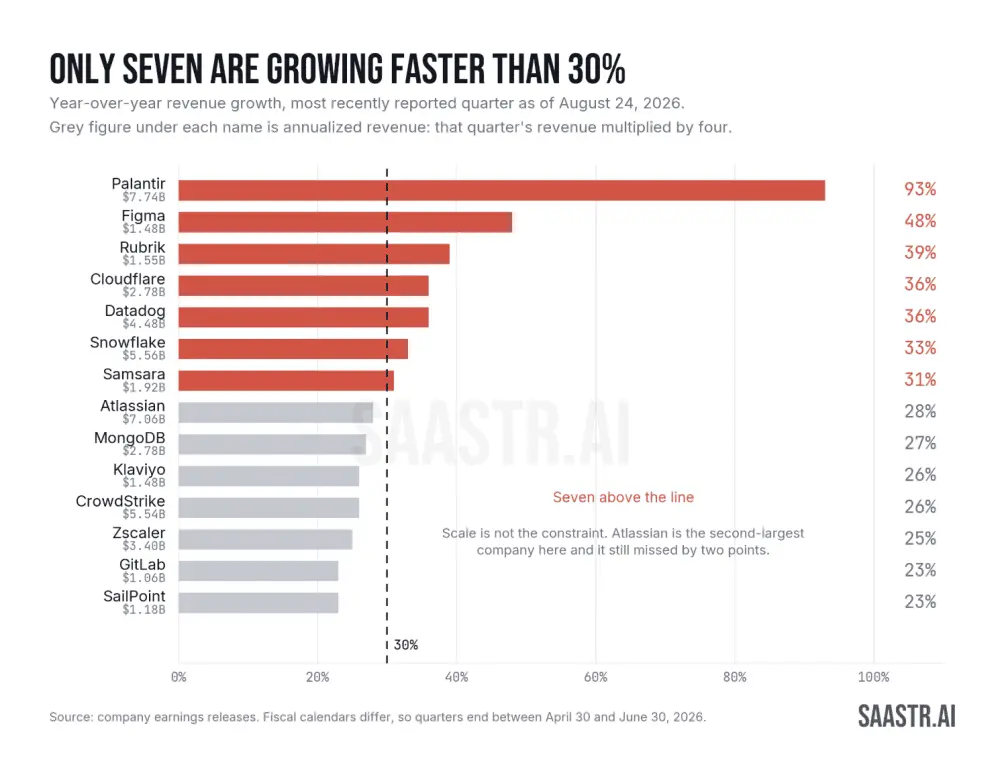
Scarcity Defines the Current Growth Landscape
Just seven publicly traded business-to-business software companies currently report annualized revenue growth rates above thirty percent. These figures come directly from recent quarterly earnings releases. Analysts calculate this metric by multiplying the latest quarter’s revenue by four. This method creates a standardized baseline for comparison across the sector. The resulting numbers reflect current momentum rather than historical averages.
Breaking news
 Town AI Secures $108 Million Series B, Valued at $1 Billion After $55 M Pre‑Series
 Apple Prepares for Major Product Launch Event on October 28
 Apple Releases Release Candidates for watchOS, tvOS and visionOS 27.2
 Apple Limits iPhone Duo and iPhone 18 Pro Max to Reservation-Only Sales in Japan and South Korea
The calculation provides a rough estimate of annual performance. For firms with significant seasonal fluctuations, the actual yearly total may vary slightly. However, this approach allows investors to compare disparate companies on equal footing. It aligns their results with standard run-rate expectations used in financial modeling. This consistency helps identify which leaders maintain strong expansion despite market headwinds.
The limited number of high-growth players highlights a broader trend in the software industry. Most established B2B vendors have slowed their pace as they mature. Achieving triple-digit or even double-digit growth is increasingly rare among large-cap stocks. The seven companies identified represent a distinct cohort of outliers. They continue to expand rapidly while peers struggle to maintain single-digit gains. This divergence signals a shift in investor focus toward proven scalability.
Can AI-Native Startups Outpace Legacy Leaders?
In the context of artificial intelligence, this group faces specific scrutiny. Many market participants label new entrants as „AI-native.”However, only a handful of these newer firms match the growth velocity of the established seven. If an AI-focused startup joins this elite tier, it would likely rank near the bottom. This dynamic suggests that legacy software giants still hold a structural advantage in scaling revenue. Newer competitors must outperform entrenched players to claim top positions in growth rankings.
The question remains whether emerging AI companies can overtake the current leaders. The existing seven firms benefit from deep enterprise relationships and diversified product suites. Their growth stems from broadening adoption across multiple verticals. In contrast, AI-native startups often rely on a single breakthrough technology. This concentration of risk can limit sustainable expansion rates. Investors watch closely to see if any newcomer breaks into the top ranks.
Data from recent reports shows the gap between the leaders and the rest of the field. The threshold of thirty percent growth serves as a critical benchmark. Falling below this line often triggers re-evaluations of valuation multiples. Companies that sustain this pace demonstrate resilience against economic uncertainty. The scarcity of such performers makes each addition to the list a notable event. Market analysts track these shifts to predict future leadership changes in the sector.
Frequently Asked Questions
How is the growth rate calculated for these companies? Analysts multiply the revenue from the most recent quarter by four. This creates an annualized figure that approximates full-year performance. It provides a consistent metric for comparing different firms.
Why is the thirty percent threshold significant? This rate separates high-growth firms from those experiencing moderate expansion. Only seven public B2B companies currently clear this bar. It indicates exceptional market demand and successful execution.
Does seasonality affect these calculations significantly? It can introduce minor discrepancies for some firms. However, the method remains a reliable proxy for run-rate performance. It allows for fair comparisons across the entire industry.