Global IT Spending Outlook
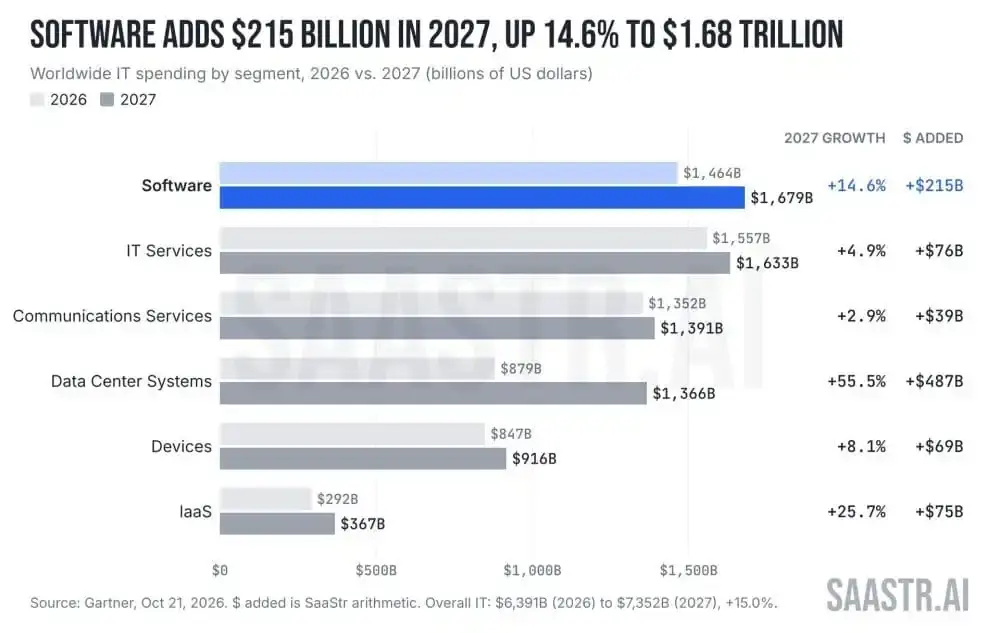
Global IT spending is set to hit $7.35 trillion in 2027. This represents a 15% annual increase. Global IT spending will surpass $7 trillion for the first time. While data center infrastructure adds $487 billion in 2027, software's role is increasingly prominent within B2B and AI contexts.
Breaking news
 Samsung Shifts Galaxy Watch Strategy to Two-Year Release Cycle
 Tesla rolls out FSD v15 with major safety upgrade
 Open-Source Tools Challenge AI-Powered Development Platforms
 AI Infrastructure Bottlenecks: Why Release Pipelines Hold Back Fast Clusters
Software Market Breakdown
The software market is estimated at $1.464 billion in 2026. This shows a 15.2% growth from the previous period. By 2027, software is projected to reach $1.679 billion, marking a 14.6% increase. Data center systems will reach $1.366 billion, growing 55.5% by adding $487 billion. IT services will grow from $1.557 billion in 2026 to $1.633 billion in 2027, a 4.9% rise. IaaS expands from $292 billion in 2026 to $367 billion in 2027, a 25.7% expansion. Devices will reach $916 billion in 2027, up from $847 billion in 2026 (8.1% growth). Communications services will grow 2.9% to $1.391 billion from $1.352 billion in 2026. Total spending across all categories reaches $7.352 trillion in 2027, a 15.0% jump from $6.391 trillion in 2026, adding $961 billion overall.
Software's Contribution and Adjustments
Software contributes $215 billion in just one year. This places it second only to data center systems in financial contribution. Gartner previously forecast software at $1.433 billion for 2026, expecting 11.9% growth from $1.244 billion in 2025. This 2026 estimate was revised upward by $31 billion to $1.464 billion. Thus, total new software spending from 2025 to 2027 is estimated around $435 billion.
Market Share Dynamics
Software accounts for 22.9% of IT spending in 2026. It remains at 22.8% in 2027. Data centers increase their share from 13.8% to 18.6% of total IT. Software maintains a stable proportion amid this tech boom. AI infrastructure captures much of the market growth. Lovelock noted that digital economy growth depends on funding and monetizing AI infrastructure, not just software adoption.
Drivers of Growth
The 14.6% growth appears uniform but masks diverse segments. Gartner details show GenAI models growing spectacularly at 117%. This falls under general software. A large part of the $215 billion addition comes from a few model vendors. AI application development platforms are projected to grow 39%, funding in-house development. Established companies often use embedded AI models.
Adoption Trends and Pricing
Enterprises prefer integrating simpler AI features into core systems first. Lovelock also stated that rising software costs stem from GenAI functionality improvements and price hikes. A large portion of the 14.6% growth comes from higher license fees. This is supplemented by AI modules and usage metering. Many standard B2B applications grow below the 14.6% average.
Future Financial Practices
Gartner predicts Global 500 firms will adopt real-time FinOps AI by 2028. They will shift from retrospective cost reporting. This requires new roles linking token-based spending to business outcomes. Auditing API interactions can reveal redundant usage, leading to revenue savings.
Application Development Horizon
By 2029, four out of five new applications will be short-lived. AI enables employees to quickly build temporary solutions. This aligns with the 39% growth in AI development platforms.