Bridging the Hardware-Software Gap
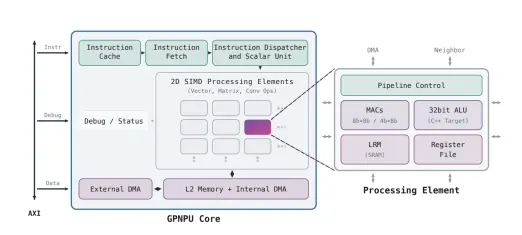
Engineers have unveiled a new processor architecture designed to handle scalar, vector, and matrix execution within a single instruction set. This breakthrough, presented in a recent technical paper, aims to streamline generative AI workloads. By unifying these functions under one C++ programming model, the design offers unprecedented flexibility for developers working in rapidly shifting AI environments.
Breaking news
 AI Models Can Be Easily Modified to Assist Terrorist and Extremist Activity
 The New Era of Autonomous Software Engineering
 Qualcomm Wins Legal Battle Against Arm But Award Is Minimal
 The Illusion of AI Expertise Among Men
The current landscape of generative AI moves at a breakneck pace. New attention mechanisms, complex quantization formats, and innovative routing schemes emerge every quarter. Traditional fixed-function neural processors struggle to keep up because their hardware cannot be easily updated. This new General-Purpose Neural Processor, or GPNPU, addresses these limitations by providing a programmable foundation that adapts to software changes without requiring expensive hardware redesigns.
The primary challenge in AI acceleration is the disconnect between rigid silicon and fluid software research. When a new optimization technique appears, current neural processors often become obsolete before the next production cycle begins. The GPNPU architecture solves this by integrating diverse computational requirements into one unified framework. Developers can now implement cutting-edge algorithms using familiar C++ tools, drastically reducing the time required to deploy new models.
Can Unified Architecture Outpace Fixed-Function Silicon?
By consolidating execution types, the processor eliminates the overhead associated with moving data between specialized units. This efficiency is critical for modern generative models that demand high memory bandwidth and massive parallel processing capabilities. The design ensures that as AI research evolves, the underlying hardware remains relevant and capable of executing the latest mathematical operations efficiently.
The shift toward a unified ISA represents a fundamental change in how we approach AI hardware. Instead of building static chips for specific tasks, manufacturers can now provide a versatile platform that grows alongside the software ecosystem. This approach effectively decouples hardware development cycles from the rapid iteration of AI research, ensuring that compute resources are always ready for the next breakthrough.
Frequently Asked Questions
As the industry moves away from rigid, single-purpose silicon, the GPNPU could become the standard for research labs and commercial enterprises alike. This flexibility lowers the barrier to entry for deploying complex AI, fostering a more dynamic environment for innovation. Ultimately, this architecture guarantees that computational power can keep stride with the accelerating pace of generative AI development.
Why is the GPNPU better than traditional processors? It combines scalar, vector, and matrix execution into one architecture. This allows it to adapt to new AI software trends without needing hardware changes.
What programming language does this architecture support? The system utilizes a standard C++ programming model. This makes it easier for developers to implement new AI techniques without learning proprietary hardware languages.