How Do Old Phones Power a Walking Robot?
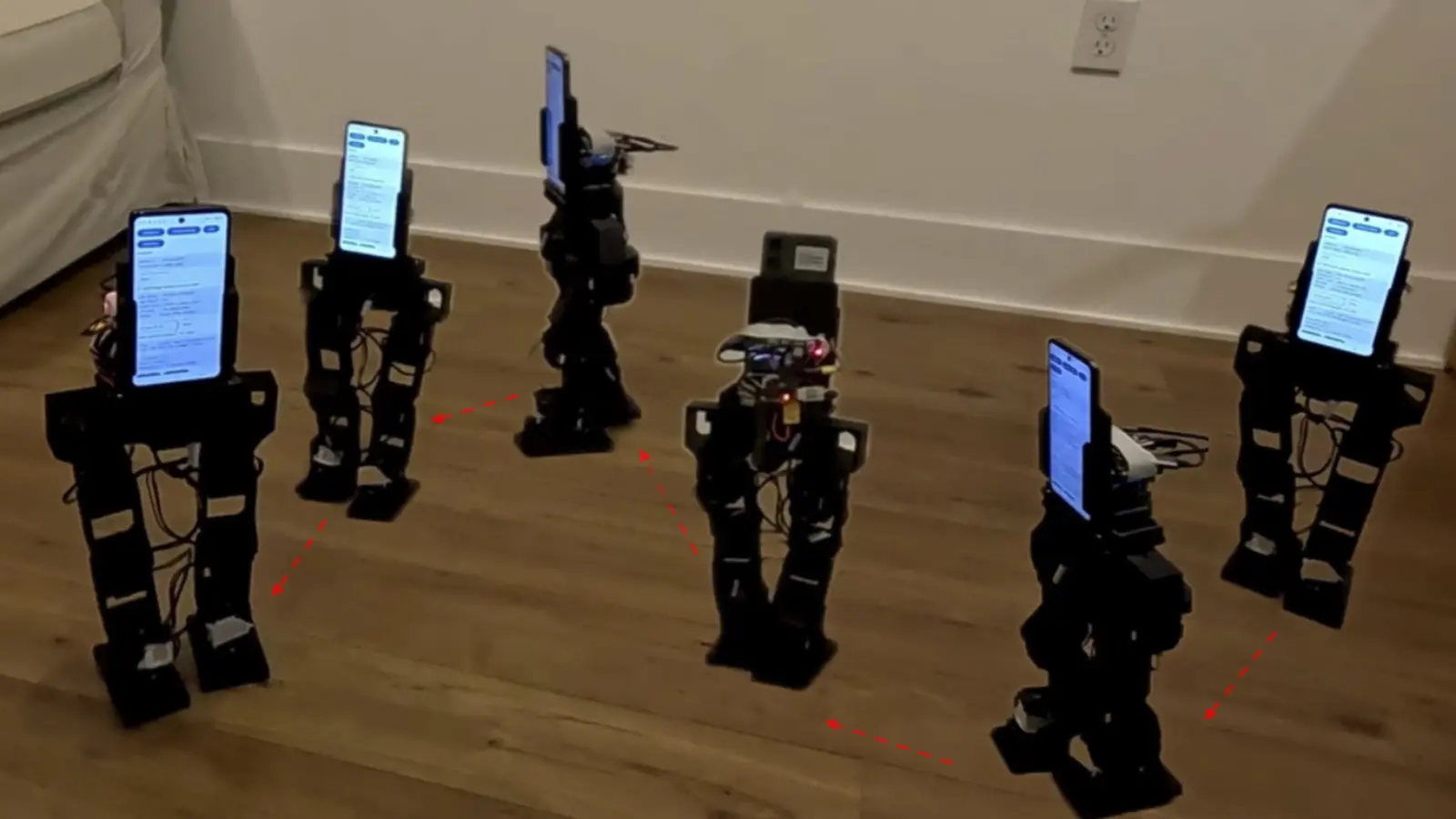
UCLA researchers have created PhoneBot, a compact humanoid robot built using four inexpensive Android smartphones as its primary sensing and computing system, with total hardware costs under $400. Developed in a university robotics lab, the project demonstrates how everyday mobile devices can be repurposed for advanced robotic functions including vision, motion control, and environmental awareness.
Breaking news
 Town AI Secures $108 Million Series B, Valued at $1 Billion After $55 M Pre‑Series
 Apple Prepares for Major Product Launch Event on October 28
 Apple Releases Release Candidates for watchOS, tvOS and visionOS 27.2
 Apple Limits iPhone Duo and iPhone 18 Pro Max to Reservation-Only Sales in Japan and South Korea
Each smartphone in PhoneBot serves a specific role: two act as stereo cameras for depth perception, one processes inertial data for balance and walking, and the fourth manages communication and high-level decision-making. By leveraging the built-in sensors, processors, and cameras of these low-cost devices, the team avoided expensive custom hardware while maintaining sufficient performance for basic humanoid locomotion and interaction. The robot’s software is open source, allowing others to replicate and modify the design.
Can This Approach Make Robotics More Accessible?
The Android phones run a lightweight Linux-based operating system customized for real-time control, enabling synchronized data sharing between units over Wi-Fi. This distributed system handles tasks like obstacle detection, gait adjustment, and posture stabilization without relying on a central processor. Researchers noted that while individual phones lack the power of dedicated robotics boards, their combined use provides redundancy and flexibility. The design also simplifies troubleshooting—faulty units can be swapped out easily using standard phone hardware.
By using widely available consumer electronics, PhoneBot lowers the barrier to entry for robotics experimentation, particularly for educators, hobbyists, and labs with limited funding. The team emphasizes that the goal isn’t to replace industrial robots but to inspire innovation through affordable, transparent platforms. Future work may focus on improving battery life, refining walking algorithms, and integrating additional sensors like microphones or environmental monitors. The open-source nature of the project invites global collaboration to expand its capabilities.
What makes PhoneBot different from other low-cost robots? Unlike robots that use microcontrollers or single-board computers, PhoneBot relies entirely on repurposed smartphones for both sensing and computation, exploiting their integrated cameras, IMUs, and processing power at a fraction of the cost.
Frequently Asked Questions
How much did the hardware actually cost? The total hardware expenditure was approximately $400, with each Android phone acquired for around $50, making it significantly cheaper than most humanoid research platforms.
Is the software available for others to use? Yes, the control software and system architecture are released as open source, allowing researchers and developers to download, modify, and deploy the system on similar hardware configurations.