How Does PhoneBot Use Smartphone Hardware for Movement?
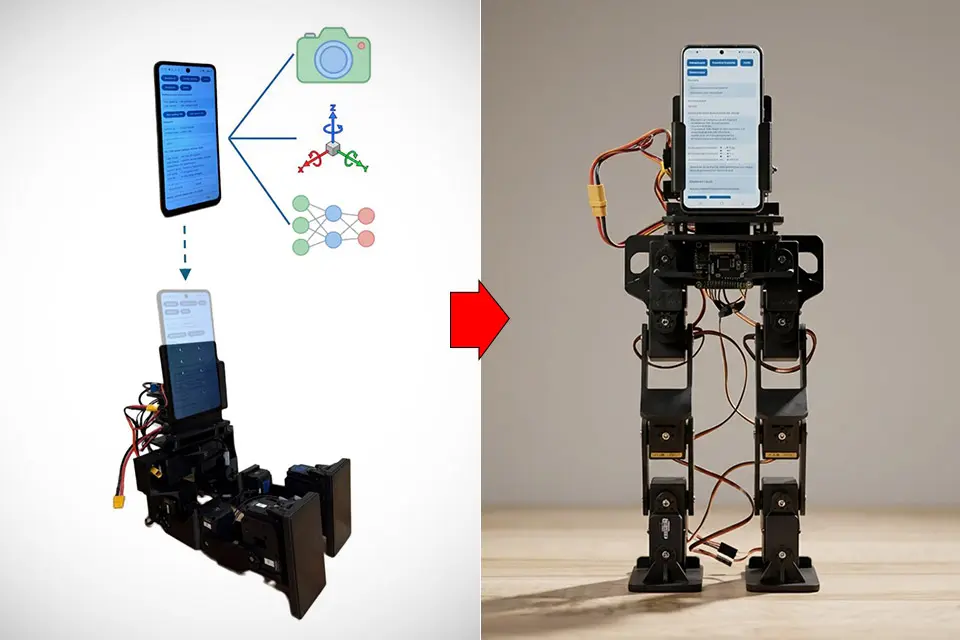
Researchers at UCLA's Robotics and Mechanisms Laboratory have developed PhoneBot, a system that repurposes old Android smartphones as the central processing unit for small walking robots. The project, unveiled in October 2026, transforms unused devices into functional companions capable of basic locomotion and interaction. By leveraging the phone's existing sensors, camera, and computing power, the team created a low-cost platform for educational and personal robotics applications.
Breaking news
 Chinese Firms Secure Over One Million Nvidia Graphics Cards for AI Development
 Accenture Market Cap Surges to $130B Ahead of Investor Day
 Paris Startup Naboo Rebrands to Target Finance and Procurement Teams
 Improving Data Integrity in Automated Document Processing
The PhoneBot design integrates a 3D-printed mechanical frame with servo-driven legs that attach to a standard smartphone mounted vertically. The device runs custom software that processes input from its accelerometer, gyroscope, and visual sensors to maintain balance and navigate simple environments. Power is drawn directly from the phone's battery, eliminating the need for separate power systems. According to lead researcher Ruochen Hou, the system achieves stable walking gaits at speeds up to 0.5 meters per second on flat surfaces, with obstacle avoidance enabled through real-time image processing.
What Limitations Exist in Current PhoneBot Iterations?
The robot's control system relies on the smartphone's built-in inertial measurement unit to detect tilt and adjust leg motor commands in real time, mimicking biological balance mechanisms. Computer vision algorithms analyze footage from the rear camera to identify obstacles and adjust path planning, while the touchscreen serves as an interface for basic user commands. This approach reduces component costs by approximately 70% compared to traditional microcontroller-based robots, making advanced mobility accessible for STEM education initiatives.
Current prototypes function best on smooth, level surfaces and struggle with inclines exceeding 15 degrees or uneven terrain like carpet. Battery life varies depending on the phone model but typically supports 20-30 minutes of continuous operation before requiring recharge. The team acknowledges that processing demands from simultaneous locomotion and vision tasks can cause thermal throttling in older devices, though they note most modern smartphones handle the workload adequately for demonstration purposes.
Can PhoneBot work with i Phones or only Android devices? The current implementation requires Android due to deeper hardware access permissions, though researchers are exploring iOS compatibility through alternative development frameworks.
Frequently Asked Questions
Is PhoneBot safe for children to use unsupervised? While designed with rounded edges and low-force actuators, adult supervision is recommended for users under 12 due to small parts and electronic components.
How much does it cost to build a PhoneBot at home? Excluding the smartphone, the mechanical components and software can be assembled for under $25 using publicly available design files and open-source code.