Dual-Sided Mounting Enables Unprecedented Bandwidth
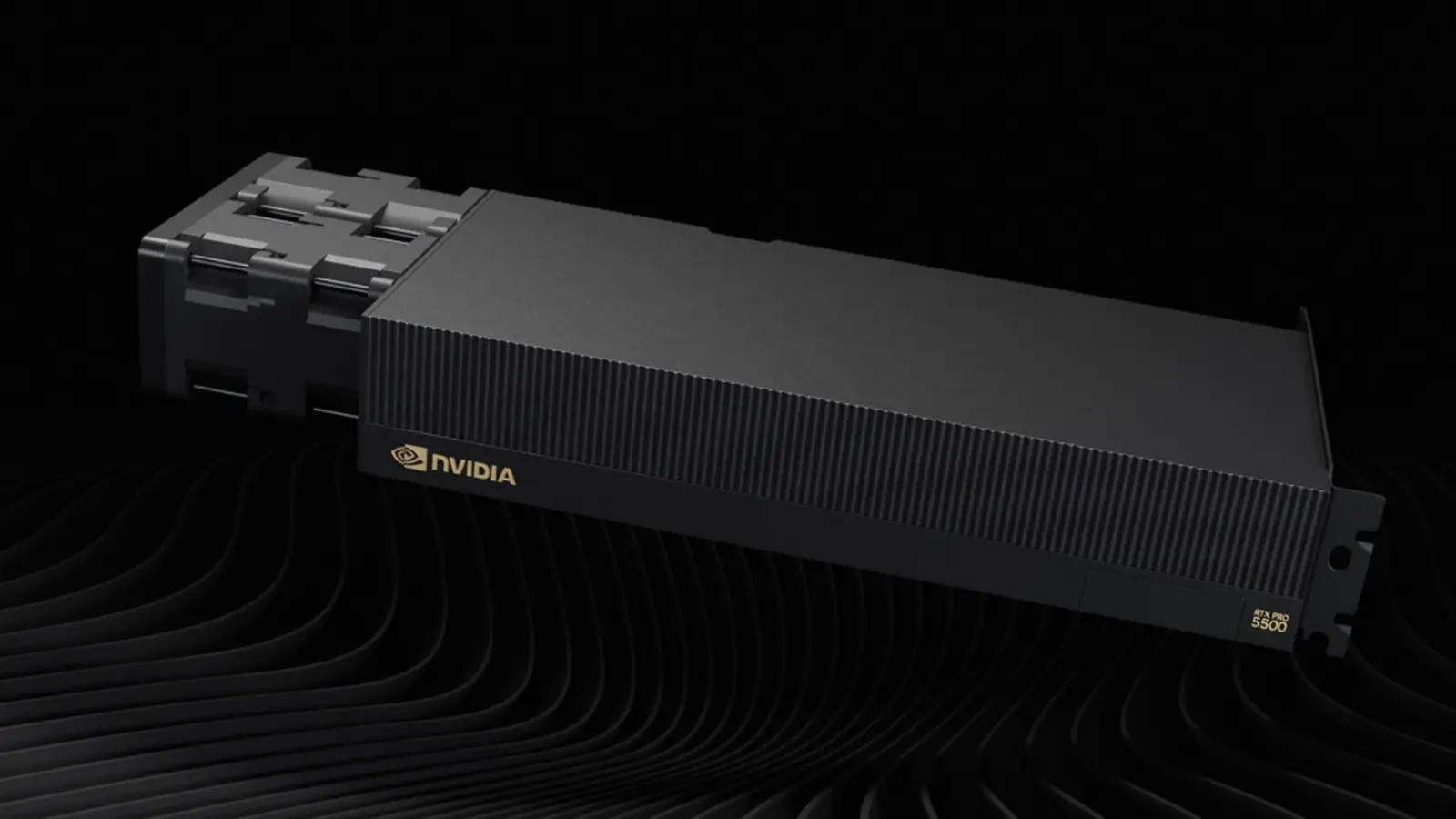
Nvidia has officially launched the RTX Pro 5500, a high-end workstation graphics card designed for professional creative workflows. The new hardware features a substantial 84 gigabytes of GDDR7 memory, setting it apart from competitors in the same tier. This release targets users who require extreme data throughput without relying solely on external storage systems. The card is built on the latest Blackwell architecture, ensuring peak performance for modern AI and rendering tasks.
Breaking news
 Why Authentic Social Signals Matter for AI Training Data Quality
 How Passive Mobile Execution Is Reshaping Digital Labor Economics
 Algorithmic Transparency: How Quantitative Discipline Reshapes Digital Asset Markets
 Why Technical SEO Scanning Is Essential for Modern Web Performance
The core innovation lies in how Nvidia manages this vast amount of memory on a single printed circuit board. The company utilized a dual-sided mounting strategy to accommodate the extra capacity. Fourteen memory chips are soldered to the top surface of the board, while another fourteen are placed on the bottom side. This arrangement allows the card to hold twenty-eight individual GDDR7 modules within its physical footprint. Such density is rare for consumer or prosumer graphics cards, which typically mount memory only on one side.
This sandwich technique addresses a critical bottleneck in professional computing. High-resolution video editing and large language model inference demand rapid data access. By distributing the memory chips across both faces of the PCB, Nvidia maintains signal integrity while maximizing total capacity. The card operates with a 416-bit memory bus, a configuration that is highly unusual for standard graphics processing units. Most competitors stick to 256-bit or 384-bit interfaces. The wider bus width enables the 84GB pool to feed the 21,760 CUDA cores efficiently. This design choice prioritizes raw bandwidth over traditional compactness, catering to workstations where space is less of a constraint than speed.
Why Does This Card Target Professional Users?
Professionals often face scenarios where local memory limits slow down complex projects. The RTX Pro 5500 eliminates the need for frequent swapping to system RAM. It supports advanced error correction and reliability features expected in enterprise environments. The inclusion of GDDR7 technology ensures faster clock speeds compared to previous generations. This makes the card suitable for real-time ray tracing and heavy neural network training. The dual-sided layout also helps manage thermal distribution, as heat can dissipate from both sides of the board.
The launch positions Nvidia firmly in the premium workstation segment. Competitors will likely respond with similar high-capacity solutions in the coming months. For now, the RTX Pro 5500 offers a distinct advantage in memory density. Users can expect improved stability for long-running simulations and large dataset processing. The focus on internal memory capacity suggests a shift toward self-contained powerful nodes. This trend may influence future desktop and laptop designs, pushing boundaries for onboard storage and processing power.
Frequently Asked Questions
How much memory does the RTX Pro 5500 contain? The card includes 84 gigabytes of GDDR7 memory. This capacity is significantly higher than most current professional GPUs. It allows for handling massive datasets directly on the graphics processor.
What is the memory bus width of this new card? The RTX Pro 5500 utilizes a 416-bit memory interface. This wide bus facilitates high-speed data transfer between the memory chips and the GPU core. It supports the high bandwidth required for professional applications.
Is the memory mounted on both sides of the board? Yes, the design places fourteen memory chips on the top and fourteen on the bottom. This sandwich approach maximizes the usable area on the PCB. It enables the high capacity without increasing the card's overall length.